High-Yield Savings vs. Treasury Bills (T-Bills): State Tax Optimization & Liquidity Guide
Why are savvy cash managers and emergency fund depositors in high-tax states switching from High-Yield Savings Accounts (HYSA) to U.S. Treasury Bills to capture higher after-tax yields and unlimited sovereign safety? When interest rates on short-term liquidity instruments exceed 4% to 5%, optimizing the return on cash reserves becomes a substantial financial lever. However, focusing solely on nominal Annual Percentage Yield (APY) obscures a major cash drain: state and local income taxes. Because interest on federal obligations is statutorily exempt from all state and local taxation under federal law, Treasury Bills (T-Bills) frequently outperform HYSAs by 50 to 100+ basis points in net after-tax cash returns. This guide explores the statutory frameworks, mathematical yield formulas, sovereign safety guarantees, and automated liquidity laddering strategies that define high-efficiency cash management.
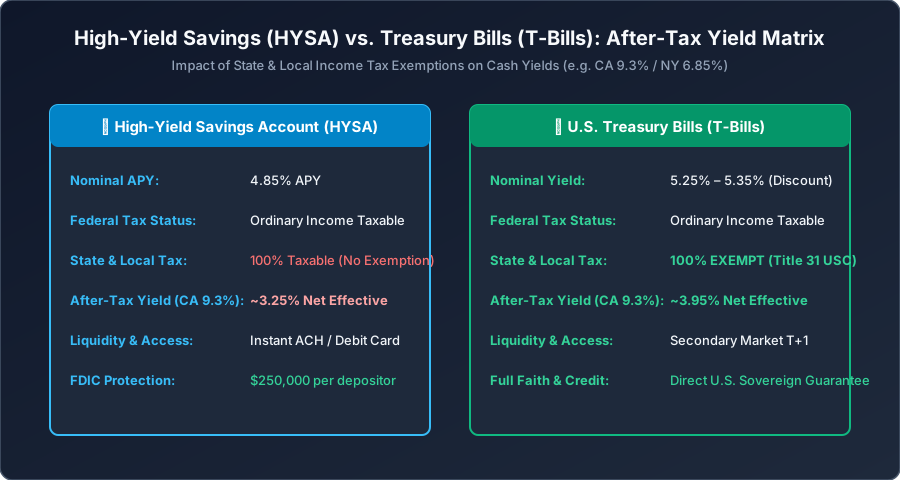
1. Federal Statute 31 U.S. Code § 3124: The State Tax Shield
The primary structural divergence between bank deposits and federal sovereign debt lies in their tax treatment. Interest generated by High-Yield Savings Accounts, certificates of deposit (CDs), and standard money market deposit accounts is categorized as ordinary income and is subject to full taxation at both the federal marginal rate and state/municipal marginal income tax rates.
Conversely, Title 31 of the United States Code, Section 3124(a) explicitly codifies the constitutional doctrine of intergovernmental tax immunity:
"Stocks and obligations of the United States Government are exempt from taxation by or under State or municipal or local authority. The exemption extends to every form of taxation that would require the obligation, the interest on the obligation, or both, to be considered in computing a tax..."
Because of this federal shield, the interest earned on U.S. Treasury Bills is reportable on federal income tax returns (IRS Form 1040), but is 100% exempt from all state and local income taxes. For taxpayers residing in states with significant income tax rates, this statutory distinction translates directly into higher net cash in your pocket.
2. The Mathematics of After-Tax Yield & Tax-Equivalent Yield (TEY)
To make an accurate comparison between an HYSA and a Treasury Bill, depositors must calculate the Tax-Equivalent Yield (TEY)—the nominal APY that a fully taxable bank account would need to generate to match the after-tax yield of a state-tax-exempt T-Bill:
TEY = T-Bill Nominal Yield ÷ [ 1 - State Marginal Tax Rate ]
After-Tax Net Yield Formulas:
Net HYSA Yield = Nominal APY × [ 1 - (Federal Tax Rate + State Tax Rate) ]
Net T-Bill Yield = Nominal Yield × [ 1 - Federal Tax Rate ]
Consider an empirical comparison for a depositor in the 24% Federal tax bracket residing in California with a 9.3% State marginal rate (33.3% combined tax bracket), comparing a 4.75% HYSA against a 5.20% 4-Week T-Bill on a $100,000 cash reserve:
| Yield & Cash Return Metric | High-Yield Savings (HYSA) | 4-Week Treasury Bill (T-Bill) | Net Advantage |
|---|---|---|---|
| Nominal Headline APY / Yield | 4.75% | 5.20% | +45 bps in headline yield |
| Federal Tax Drag (24%) | -$1,140 ($4,750 × 0.24) | -$1,248 ($5,200 × 0.24) | Identical federal rules |
| State Tax Drag (9.3% CA) | -$442 ($4,750 × 0.093) | $0.00 (Exempt under § 3124) | +$442 state tax savings |
| Net After-Tax Cash Return | $3,168 (3.17% Net Yield) | $3,952 (3.95% Net Yield) | +$784 in pure after-tax profit (+24.7%) |
| Tax-Equivalent Yield (TEY) | 4.75% | 5.73% TEY | HYSA would need 5.73% to compete |
In states with combined state and local taxes exceeding 10% (such as New York City with combined top rates above 14%), the Tax-Equivalent Yield rises even further, making Treasury Bills an indispensable cash management vehicle for liquidity preservation.
3. Safety & Counterparty Risk: FDIC Insurance vs. Sovereign Backing
Beyond tax efficiency, the structural credit backing of the two instruments differs substantially:
- High-Yield Savings Accounts (FDIC Insurance): Bank deposits are insured by the Federal Deposit Insurance Corporation (FDIC) up to a statutory limit of $250,000 per depositor, per insured bank, per account ownership category. While this provides exceptional safety for typical balances, individuals or businesses holding $500,000 or $1,000,000+ in liquid cash must navigate complex multi-bank accounts or participate in deposit sweep networks (such as IntraFi / CDARS) to avoid uninsured bank failure risk.
- U.S. Treasury Bills (Full Faith & Credit): Treasury Bills are direct short-term sovereign obligations of the United States Government. They are backed by the full faith, credit, and taxing authority of the world's largest sovereign economy, with zero dollar caps or balance ceilings. A depositor can hold $10,000, $500,000, or $50,000,000 in T-Bills with identical sovereign backing.
4. Execution & Purchasing Mechanics: TreasuryDirect vs. Brokerage Platforms
Retail investors can acquire U.S. Treasury Bills through two primary operational channels:
1. TreasuryDirect.gov
TreasuryDirect is the official portal operated by the U.S. Department of the Treasury's Bureau of the Fiscal Service. Through TreasuryDirect, individuals can purchase T-Bills directly at periodic auctions with a minimum investment of just $100. Key characteristics include zero fees, zero commissions, and an automated "Auto-Reinvest" feature that can roll maturing bills for up to two years. However, the legacy web interface lacks modern mobile responsiveness, and transferring funds back to an external checking account can require multiple business days.
2. Major Brokerage Platforms (Fidelity, Schwab, Vanguard)
Purchasing Treasury Bills through a major national brokerage account provides distinct advantages. Brokerages permit participation in weekly non-competitive Treasury auctions with $0 commissions while also providing access to the highly liquid secondary market. If you encounter an unexpected financial emergency and require immediate liquidity before your T-Bill matures, you can sell the bill on the secondary market during market hours and settle the cash without penalty, whereas premature redemption on TreasuryDirect is significantly more cumbersome.
5. Building an Automated Rolling T-Bill Liquidity Ladder
The optimal liquidity architecture for an emergency fund does not choose between HYSAs and T-Bills—it integrates both into an automated Rolling Liquidity Ladder:
| Tier | Allocation | Vehicle | Liquidity Access Horizon |
|---|---|---|---|
| Tier 1: Instant Float | 1 Month Expenses ($5,000) | High-Yield Savings (HYSA) | Instant (ATM, Debit, Same-Day ACH) |
| Tier 2: Tranche A (Week 1) | 1.25 Months ($6,250) | 4-Week T-Bill (Auto-Roll) | Matures every 4th Tuesday |
| Tier 2: Tranche B (Week 2) | 1.25 Months ($6,250) | 4-Week T-Bill (Auto-Roll) | Matures every 4th Tuesday (+1 wk) |
| Tier 2: Tranche C (Week 3) | 1.25 Months ($6,250) | 4-Week T-Bill (Auto-Roll) | Matures every 4th Tuesday (+2 wks) |
| Tier 2: Tranche D (Week 4) | 1.25 Months ($6,250) | 4-Week T-Bill (Auto-Roll) | Matures every 4th Tuesday (+3 wks) |
Under this 4-week rolling ladder structure, 25% of your secondary emergency cash matures into liquid settlement cash every seven days. If no emergency occurs, the auto-roll reinvests the principal seamlessly into a fresh 4-week bill at current market yields. If a liquidity need arises, you simply deactivate auto-roll on the next maturing tranche, capturing tax-advantaged sovereign returns without sacrificing cash flow flexibility.
Cash 4 You Live Editorial & Consumer Advocacy Board
Our financial literacy researchers and regulatory analysts publish independent guides on Truth in Lending APR compliance, credit union PAL alternatives, and state usury statutes.