Debt Consolidation vs. Debt Settlement: Credit Score Impact, Taxes & Cost Analysis
What is the critical distinction between a debt consolidation loan that protects your credit score and a for-profit debt settlement program that triggers devastating 100+ point credit drops and surprise IRS tax liabilities? Aggressive advertising frequently blurs the line between these two fundamentally opposing financial solutions. While both promise lower monthly payments and relief from unmanageable balances, their legal mechanics, credit reporting consequences, and total net costs could not be more divergent. This guide provides an objective, rigorous comparison of consolidation installment loans, non-profit debt management plans, and debt settlement programs under federal tax and consumer credit laws.
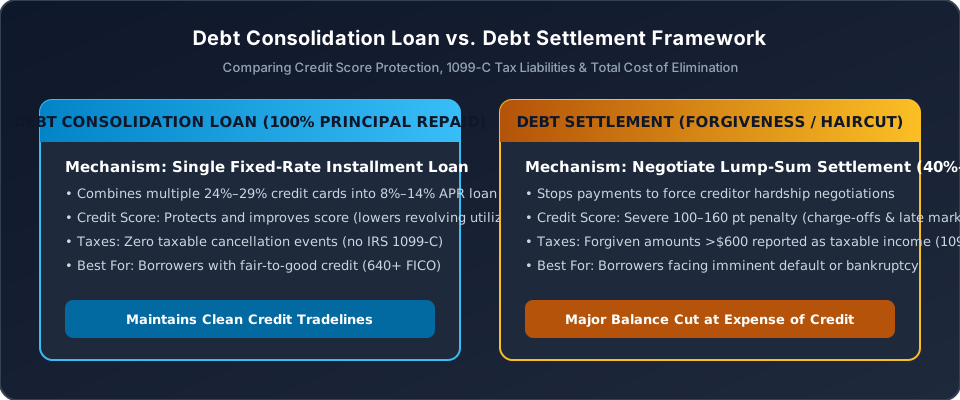
1. Debt Consolidation Loans: Fixed-Rate Principal Restructuring
A Debt Consolidation Loan is an unsecured installment loan obtained from a bank, credit union, or online lender specifically to pay off multiple high-interest revolving credit lines in full. Under this model, 100% of the principal owed is repaid, but the debt is restructured into a single fixed monthly payment at a substantially reduced interest rate (e.g., 9% to 14% APR compared to credit card rates of 24% to 29%).
Core Benefits of Consolidation Loans:
- Immediate Credit Score Enhancement: When the loan proceeds disburse to pay off your credit cards, your revolving credit utilization drops to 0% overnight. Because utilization accounts for 30% of your FICO score, borrowers often experience an immediate 40-to-80-point credit score surge.
- Zero Tax Consequences: Because no debt is forgiven, canceled, or written off, there is zero taxable event and zero IRS reporting.
- Predictable Fixed Amortization: Unlike revolving credit minimums that stretch repayment over 20 to 30 years, consolidation loans feature fixed amortization schedules of 36 to 60 months with a defined debt-free date.
Underwriting Requirements & Potential Pitfalls:
To qualify for an attractive interest rate on an unsecured consolidation loan, lenders typically require a credit score of 640 or higher, verifiable steady income, and a debt-to-income (DTI) ratio below 40%. Additionally, borrowers must account for origination fees (typically 1% to 6% of the loan amount deducted from proceeds) and avoid the dangerous behavioral trap of running up fresh credit card balances after clearing their limits.
2. Debt Settlement: The Forgiveness Model & Delinquency Hazards
In contrast to consolidation, Debt Settlement (often marketed by for-profit companies as "debt relief" or "debt forgiveness") is a high-risk negotiation strategy where you intentionally pay less than the full balance owed—typically negotiating a lump-sum payoff equal to 40% to 60% of your outstanding debt.
How For-Profit Debt Settlement Actually Operates:
Creditors will never negotiate or accept a discounted settlement on an account that is being paid on time. Therefore, debt settlement companies instruct you to halt all monthly payments to your creditors immediately. Instead, you deposit monthly funds into a dedicated third-party escrow account. Once your accounts fall 90 to 180 days delinquent and charge off, the settlement firm approaches the creditor to negotiate a discounted settlement using the escrowed cash.
The Severe Real-World Penalties of Debt Settlement:
- Devastating Credit Destruction: Intentionally missing payments triggers cascading 30-, 60-, 90-, and 120-day late marks, followed by formal charge-offs, third-party collection transfers, and "Settled for Less Than Full Balance" tradeline notations. Your FICO score will crash by 100 to 160+ points, and derogatory marks will linger for 7 years under FCRA § 605.
- Creditor Lawsuit & Wage Garnishment Risk: Creditors are under no legal obligation to settle. Many major card issuers routinely sue borrowers who stop paying, obtaining civil court judgments that result in wage garnishments, bank account levies, and judgment liens against real property.
- Exorbitant Settlement Fees: For-profit settlement companies typically charge contingency fees of 15% to 25% of the total enrolled debt (or 20% to 35% of the debt saved). These fees dramatically erode the net financial benefit of settlement.
3. The Hidden Tax Bomb: IRS Form 1099-C & Cancellation of Debt
The most overlooked danger in debt settlement is federal and state taxation. Under Internal Revenue Code § 61(a)(11), gross income includes "income from discharge of indebtedness." When a creditor forgives $600 or more of debt, they are statutorily required to file IRS Form 1099-C (Cancellation of Debt) with the Internal Revenue Service and mail a copy to the borrower.
Enrolled Debt Balance: $30,000
Negotiated Settlement (50%): $15,000
Debt Settlement Company Fee (20% of enrolled): $6,000
Forgiven Balance Reported on Form 1099-C: $15,000
Tax Liability (22% Federal + 6% State = 28% Combined): $15,000 × 0.28 = $4,200
Total Net Cash Outflow: $15,000 (settlement) + $6,000 (fees) + $4,200 (taxes) = $25,200
Actual Realized Savings on $30k Debt: Only $4,800 (16%), in exchange for severe credit destruction!
The Insolvency Exclusion Under IRC § 982:
Borrowers can avoid paying taxes on canceled debt only if they qualify for the Insolvency Exclusion under IRC § 108(a)(1)(B). A taxpayer is insolvent when their total liabilities exceed the total fair market value of all assets immediately prior to the discharge of debt. To claim this exemption, the taxpayer must complete and attach IRS Form 982 (Reduction of Tax Attributes) to their federal tax return, accompanied by an exhaustive balance sheet detailing all assets (retirement accounts, home equity, vehicles, cash) versus liabilities.
4. Comprehensive Solution Comparison Matrix
To choose the right path, examine how each debt relief strategy compares across critical metrics:
| Comparison Dimension | Debt Consolidation Loan | Non-Profit Debt Management (DMP) | For-Profit Debt Settlement | Chapter 7 Bankruptcy |
|---|---|---|---|---|
| Impact on Credit Score | Positive (+40 to +80 pts) via 0% card utilization. | Neutral to Minor temporary drop; accounts closed. | Severe Drop (-100 to -160 pts) from intentional default. | Catastrophic Drop (-160 to -240 pts) for up to 10 years. |
| Principal Repayment | 100% Repaid | 100% Repaid (at reduced APR of 6%–9%) | Partial (40% to 60% of balance) | 0% (Full discharge of qualifying unsecured debt) |
| IRS Tax Event (1099-C) | Zero Tax Liability | Zero Tax Liability | Yes (Taxable unless insolvent under Form 982) | Exempt from tax under Title 11 bankruptcy code |
| Creditor Lawsuit Risk | Zero (Debts paid in full) | Zero (Creditors agree to DMP terms) | High (Default invites collection litigation) | Zero (Protected by federal Automatic Stay) |
| Ideal Consumer Profile | FICO 640+, steady income, wants to protect credit. | FICO under 640, needs interest rate relief without default. | Severe distress, ineligible for DMP, avoiding bankruptcy. | Insolvent, unsecured debt exceeds 50% of annual income. |
5. Strategic Recommendation: Finding Your Clear Path
If you possess steady employment and a credit score of 620 or higher, a fixed-rate Debt Consolidation Loan or 0% APR balance transfer credit card is vastly superior, locking in substantial interest savings while preserving your credit reputation. If your credit score prevents loan approval, explore a Debt Management Plan (DMP) through a non-profit agency accredited by the National Foundation for Credit Counseling (NFCC)—they negotiate concessionary rates without forcing default. For-profit debt settlement should be evaluated strictly as an emergency alternative to bankruptcy when unsecured debt obligations exceed your capacity to repay within five years.
Cash 4 You Live Editorial & Consumer Advocacy Board
Our financial literacy researchers and regulatory analysts publish independent guides on Truth in Lending APR compliance, credit union PAL alternatives, and state usury statutes.