Building an Emergency Fund: 50/30/20 Framework & Micro-Savings Automation
How can a household living paycheck to paycheck build a resilient $1,000 to $5,000 liquid emergency reserve without feeling deprived or sacrificing baseline survival needs? The single most reliable firewall against high-cost borrowing, predatory debt cycles, and credit score destruction is liquid cash savings. Yet according to Federal Reserve economic surveys, over 37% of American adults cannot cover an unexpected $400 emergency expense using cash. Constructing an emergency cushion requires shifting away from passive "save what is left over" habits and implementing a systematic Zero-Based Cash Flow Architecture coupled with automated micro-savings protocols.
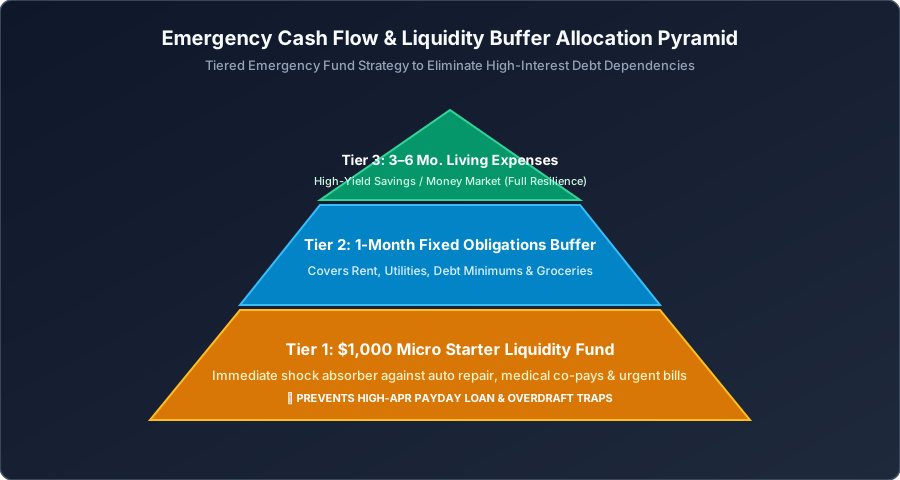
1. The 3-Tier Liquidity Buffer Hierarchy
Attempting to amass six months of living expenses immediately can feel overwhelming, leading to goal abandonment. Instead, financial engineering models structure liquidity into three discrete, achievable tiers:
Tier 1: The $1,000 Starter Buffer (Immediate Crisis Firewall)
Before accelerating debt payoffs or investing in non-retirement equities, accumulate an initial $1,000 starter emergency fund. This modest capital cushion absorbs 90% of everyday minor emergencies—such as an urgent dental filling, an unexpected school fee, a flat tire, or an emergency plumbing call. Having $1,000 in dedicated liquid cash breaks the psychological dependency on high-interest credit cards for routine disruptions.
Tier 2: The 1-Month Baseline Operational Float (Income Shock Buffer)
Once high-APR debts are systematically organized, expand savings to cover one full month of non-negotiable living expenses (mortgage/rent, utilities, baseline groceries, auto insurance). This float eliminates paycheck-to-paycheck anxiety, ensuring that if a client payment is delayed or an employer changes payroll cycles, your automated bill pay never bounces.
Tier 3: The 3-to-6 Month Comprehensive Reserve (Macro Disruption Shield)
The ultimate liquidity milestone is a fully funded 3-to-6 month reserve. Individuals with stable corporate employment or dual-income households typically maintain 3 months of baseline living expenses, whereas freelancers, commission-based sales professionals, and single-earner households should target 6 to 9 months of liquidity to weather severe economic contractions or extended job searches.
2. The 50/30/20 Cash Allocation Framework
To fund your emergency tiers, deploy the classic 50/30/20 Budgeting Rule, originated by bankruptcy scholar Senator Elizabeth Warren. This framework partitions after-tax take-home income into three clear functional buckets:
| Income Bucket | Target Allocation | Included Expense Categories | Strategic Optimization Protocol |
|---|---|---|---|
| Essential Needs | 50% of Net Pay | Rent/mortgage, utilities, groceries, transit, debt minimums. | Audit housing and transport; cap strictly at 50%. |
| Discretionary Wants | 30% of Net Pay | Dining out, streaming subscriptions, hobbies, travel, retail. | Temporarily compress to 10%–15% during Tier 1 funding. |
| Savings & Debt Acceleration | 20% of Net Pay | Emergency buffer deposits, extra principal debt paydowns. | Channel 100% of this bucket into Tier 1 buffer first. |
If your essential needs currently exceed 50% (a common reality in high-cost metropolitan areas), temporarily compress the "Wants" category down to 15% or 20% to guarantee that at least 10% to 15% of net income flows directly into emergency liquidity.
3. Automated Micro-Savings Mechanics
Relying on willpower to save money fails because human cognitive energy is depleted by daily decision fatigue. Automating micro-transfers removes human emotion and establishes mathematical consistency:
Three Proven Micro-Savings Automation Channels:
- Split Direct Deposit (Payroll Level): Most employer payroll systems permit splitting your direct deposit across multiple bank accounts. Direct 90% of your paycheck into checking for living expenses, and instruct payroll to route the remaining 10% directly into a separate high-yield savings account. You never see the money in checking, eliminating the impulse to spend it.
- Scheduled Bi-Weekly Auto-Sweeps: Configure an automated recurring transfer of $25 to $50 every Friday. A modest $35 weekly transfer accumulates $1,820 within 12 months, establishing a fully funded Tier 1 buffer with zero noticeable disruption to everyday lifestyle.
- Debit Card Round-Up Programs: Utilize micro-saving fintech tools or bank features that round up every point-of-sale purchase to the nearest dollar, sweeping the change into an emergency vault. Round-ups generate an effortless $30 to $60 in monthly savings.
4. Designing "Friction" to Protect Emergency Reserves
Where you store your emergency fund is just as critical as how much you save. If your emergency savings sits inside the same bank as your primary checking account, linked directly to your mobile banking app, the temptation to transfer $100 for weekend dining or impulse retail is immense.
To protect emergency liquidity, introduce strategic behavioral friction:
- Select an Unlinked Online High-Yield Savings Account (HYSA): Open your emergency account at a specialized online bank (such as Ally, Marcus by Goldman Sachs, or Capital One) that is completely separate from your day-to-day checking account.
- Decline Debit Cards & Paper Checks: Instruct the institution not to issue a physical debit card or checkbook for the savings account.
- Leverage the 2-Day ACH Settlement Barrier: Transferring funds from an external online HYSA back to your local checking account typically requires 1 to 2 business days via standard ACH clearing. This 48-hour delay introduces a crucial cooling-off period that prevents impulsive non-emergency withdrawals while remaining readily accessible for genuine crises.
Cash 4 You Live Editorial & Consumer Advocacy Board
Our financial literacy researchers and regulatory analysts publish independent guides on Truth in Lending APR compliance, credit union PAL alternatives, and state usury statutes.