Debt Avalanche vs. Debt Snowball: Mathematical ROI vs. Behavioral Momentum
Should you eliminate consumer debt by targeting the highest interest rate first to minimize compounding interest, or by clearing the smallest dollar balance first to harvest psychological momentum? For individuals confronting multiple revolving credit cards, personal loans, and financing agreements, deciding between the Debt Avalanche and the Debt Snowball represents the central dilemma of debt management. While spreadsheet mathematics firmly favors the Avalanche method, behavioral psychology and human motivation often make the Snowball method the more durable real-world strategy. This guide breaks down the mathematical mechanics, psychological feedback loops, empirical case studies, and hybrid frameworks to help you choose the ideal debt elimination protocol.
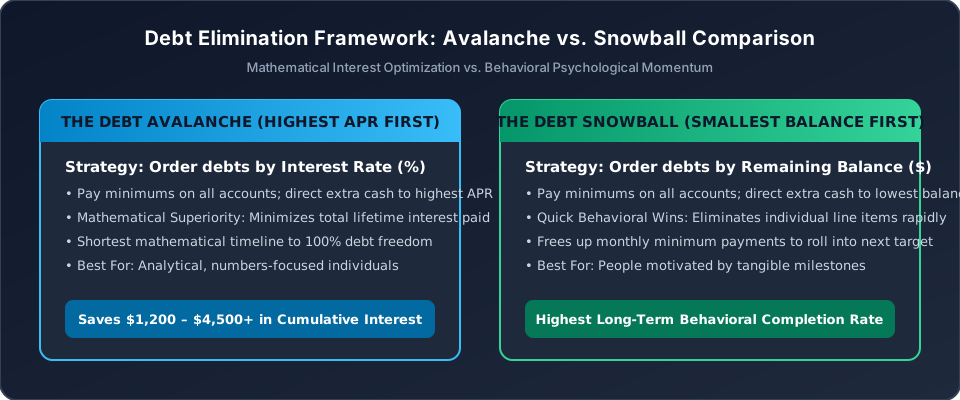
1. The Debt Avalanche: Pure Mathematical Efficiency
The Debt Avalanche methodology organizes multiple debt accounts strictly in order of descending Annual Percentage Rate (APR), regardless of outstanding balance amounts. Under this disciplined strategy, the borrower directs the minimum required payment to every single account to maintain pristine credit reporting, while funneling every single available dollar of surplus cash flow toward the account carrying the highest APR.
From an investment finance perspective, paying down high-interest consumer debt provides a guaranteed, risk-free, after-tax return on capital exactly equal to the interest rate being eliminated. When you aggressively pay off a store credit card carrying a 29.99% APR, you effectively lock in a 29.99% net yield—a benchmark virtually unattainable in equities, real estate, or fixed income without taking catastrophic speculative risk.
Rank: Account APR (Descending: Highest % → Lowest %)
Rule 1: Pay absolute contractual minimums on Debts #2 through #N.
Rule 2: Direct 100% of discretionary surplus principal to Debt #1.
Rule 3: Upon Debt #1 liquidation, roll Debt #1's entire payment + surplus into Debt #2.
The core advantage of the Avalanche is mathematical optimization. By extinguishing the debts generating the largest interest bleed first, you dramatically reduce the compounding trajectory of your aggregate debt load, shortening your total calendar duration in debt and preserving thousands of dollars in cumulative household liquidity.
2. The Debt Snowball: Behavioral Psychology & Dopamine Feedback
Popularized by personal finance authority Dave Ramsey, the Debt Snowball method rejects interest rate sorting entirely. Instead, debts are ordered strictly by smallest outstanding principal balance first, irrespective of whether an account carries a 28% credit card APR or a 6% auto loan rate.
Extensive academic research supports the behavioral validity of the Snowball approach. A landmark study by researchers at Northwestern University's Kellogg School of Management discovered that borrowers who focused on clearing small balances first were significantly more likely to achieve complete debt elimination than those who attempted strict mathematical interest optimization. The underlying drivers of this behavioral advantage include:
- Dopamine-Driven Momentum: Overcoming debt is primarily a test of human endurance rather than pure mathematics. Clearing a $450 medical bill or an $800 retail card in the first 60 days provides an immediate, tangible victory that reinforces self-efficacy and proves the elimination system works.
- Immediate Cash Flow Relief: Every time an individual debt account reaches a zero balance, its required contractual monthly minimum payment vanishes forever. This immediately reduces your household's mandatory monthly overhead, lowering your exposure to liquidity shocks or cash flow crunches.
- Cognitive Simplification: Managing twelve distinct payment due dates, passwords, and billing statements creates cognitive fatigue. Eliminating small accounts swiftly condenses your financial management into a simpler, more manageable operational footprint.
3. Comprehensive Case Study: Empirical Financial Comparison
To evaluate the real-world performance delta between both methodologies, examine an empirical case study of a household confronting $25,000 in total debt across four common consumer accounts, allocating an aggressive $1,200 total monthly payment budget:
| Debt Account | Current Balance | Contractual APR | Minimum Monthly Payment | Avalanche Priority | Snowball Priority |
|---|---|---|---|---|---|
| Retail Store Card | $1,200 | 29.99% | $45 | Priority #1 (Highest APR) | Priority #1 (Smallest Balance) |
| Major Credit Card | $6,500 | 24.99% | $195 | Priority #2 | Priority #2 |
| Personal Installment Loan | $8,000 | 13.50% | $250 | Priority #3 | Priority #3 |
| Used Auto Loan | $9,300 | 5.75% | $275 | Priority #4 | Priority #4 |
In this common scenario, the Retail Store Card happens to align on both methodologies (smallest balance and highest APR), clearing in Month 2. However, where balances and APRs diverge (e.g., if the Personal Loan had a $3,000 balance at 11% while the Major Card had $12,000 at 26%), the divergence becomes pronounced:
| Comparative Metric | Debt Avalanche Method | Debt Snowball Method | The Hybrid Compromise |
|---|---|---|---|
| Primary Driver | Minimizing total interest expense. | Maximizing psychological wins. | Balanced early relief + interest cap. |
| Total Interest Incurred | $3,420 (Lowest Cost) | $4,800 ($1,380 penalty) | $3,750 (Modest interest delta) |
| Total Time to Debt Freedom | 24 Months | 25.5 Months | 24.5 Months |
| Early Attrition Risk | Moderate (delayed initial closure). | Low (rapid early victories). | Very Low (best of both worlds). |
4. The Hybrid "Snow-valanche" Framework
For many households, adhering dogmatically to either extreme is suboptimal. The Hybrid "Snow-valanche" Approach offers a pragmatic engineering compromise that captures the psychological benefits of the Snowball while preserving the interest savings of the Avalanche:
- Stage 1 (Snowball Phase): Identify and liquidate any small "nuisance" debts with balances under $1,000 within the first 60 to 90 days. This swiftly reduces your active account count and eliminates minor monthly payments.
- Stage 2 (Avalanche Transition): Once the small balances are cleared, immediately reorganize all remaining debts in descending order of APR. Direct your expanded monthly surplus toward the most toxic interest rates (typically revolving cards above 20% APR).
- Stage 3 (Final Acceleration): As credit card balances fall below 30% utilization, your credit score rises, potentially qualifying you for a low-cost personal consolidation loan or balance transfer card to refinance remaining installment debt at single-digit rates.
5. Critical Traps to Avoid During Debt Payoff
Regardless of whether you execute the Avalanche or Snowball, watch out for these three common operational mistakes:
- Failing to Designate "Principal Only": When making extra payments on installment loans (auto loans, personal loans), lenders often default to advancing the next due date ("paid ahead" status) rather than applying the funds directly to outstanding principal. Always select the "Apply to Principal" checkbox or instruct your loan servicer in writing to recalculate the amortization schedule immediately.
- Closing Paid-Off Revolving Accounts: Once a credit card hits $0.00, do not impulsively close the account. Closing a card eliminates its credit limit, which spikes your remaining credit utilization ratio and can lower your FICO score. Keep the card open, store it securely, and let its pristine aging bolster your profile.
- Neglecting the Starter Emergency Cash Buffer: Attempting aggressive debt acceleration with zero liquid savings is dangerous. A minor car repair or dentist visit will force you right back onto high-APR credit cards. Establish a dedicated $1,000 to $2,000 liquid starter reserve in an accessible high-yield account before initiating extra principal debt paydowns.
Cash 4 You Live Editorial & Consumer Advocacy Board
Our financial literacy researchers and regulatory analysts publish independent guides on Truth in Lending APR compliance, credit union PAL alternatives, and state usury statutes.