Credit Score Repair & Rebuilding Guide: Dispute Strategies, Utilization & FICO 8 Optimization
How can a systematic understanding of the Fair Credit Reporting Act (FCRA) and revolving utilization reporting cycles elevate a credit score by 40 to 100 points without paying predatory credit repair clinics? A damaged credit profile extracts an immense financial toll—inflating mortgage rates, triggering auto financing denials, elevating security deposits on residential leases, and dramatically increasing auto insurance premiums. Rebuilding credit does not require costly proprietary agencies. By exercising your statutory consumer rights under federal law, correcting reporting discrepancies, and strategically timing your balance paydowns relative to statement closing dates, you can orchestrate a rapid, durable score rehabilitation.
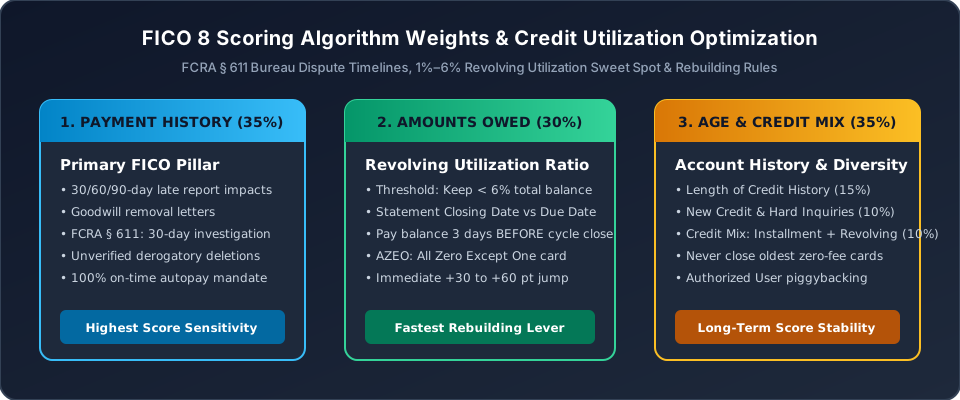
1. The Five Pillars of the FICO 8 Scoring Algorithm
While proprietary credit scoring models evolve across specialty lending verticals (such as FICO Auto Score 8 or FICO Bankcard Score 8), standard consumer credit evaluation remains overwhelmingly dominated by the classic FICO Score 8 algorithm. Achieving efficient score recovery requires directing effort toward the scoring components that carry the heaviest algorithmic weight:
1. Payment History (35% Weight)
Payment history is the single largest determinant of your creditworthiness. Scoring algorithms evaluate three dimensions of past delinquency: recency (how recently a missed payment occurred), severity (whether a delinquency was 30, 60, 90, or 120+ days late, or progressed to a charge-off), and frequency (how many individual tradelines suffered late marks). A single 30-day late payment can slash an excellent credit score by 60 to 110 points, whereas its negative impact on an already depressed profile is proportionally less severe.
2. Amounts Owed & Revolving Utilization (30% Weight)
The second most critical scoring pillar measures revolving credit utilization—the ratio between your reported revolving balances and your cumulative credit limits. Crucially, the FICO 8 algorithm calculates utilization on both an aggregate portfolio level and an individual account level. If you have $10,000 in total credit limits across four cards with a total balance of $2,000, your aggregate utilization is an optimal 20%. However, if that entire $2,000 balance resides on a single card with a $2,500 limit (80% individual utilization), the algorithm penalizes your score heavily for single-card maxing.
3. Length of Credit History (15% Weight)
This category assesses three distinct metrics: the age of your oldest active account, the average age of all your accounts (AAoA), and the duration since specific credit types were established. Closing older, unused credit cards does not immediately delete them from your FICO calculation—FICO continues to count closed accounts in good standing for up to 10 years—but it reduces your aggregate credit limit, which can spike your overall utilization ratio.
4. Credit Mix (10% Weight) & New Credit (10% Weight)
Credit mix measures your ability to prudently manage diverse credit facilities simultaneously, such as revolving credit (credit cards, lines of credit) and installment loans (fixed-payment mortgages, student loans, auto financing). New credit accounts and hard inquiries (inquiries generated when a lender evaluates your profile for new credit) compose the final 10%. Hard inquiries exert a minor scoring penalty (typically 3 to 5 points per inquiry) that dissolves within 12 months, though the inquiry remains visible on your bureau report for 24 months.
2. Asserting Statutory Dispute Rights Under FCRA § 611
The Fair Credit Reporting Act (15 U.S.C. § 1681) establishes that consumer reporting agencies (Equifax, Experian, TransUnion) and data furnishers (banks, collection agencies, loan servicers) bear the legal burden of reporting information with maximum possible accuracy. When derogatory information is inaccurate, unverified, or legally obsolete, consumers possess absolute statutory rights to demand investigation and deletion.
The 4-Step Statutory Dispute Execution Protocol:
- Obtain Raw Disclosure Reports: Pull your official credit disclosures weekly through AnnualCreditReport.com. Do not rely exclusively on consumer monitoring apps, which often omit detailed Metro 2 data fields such as date of first delinquency (DOFD) or balance history codes.
- Identify Metro 2 Compliance Inconsistencies: Cross-reference tradelines across all three bureaus. Frequent grounds for deletion include: incorrect DOFD dates, accounts listed as open that were discharged in bankruptcy, duplicate collection listings for the identical original debt, and missing original creditor identification.
- Draft Formal Written Dispute Letters (Avoid Online Portals): While credit bureau websites offer rapid web-based dispute submission, clicking "Accept" on portal terms frequently binds consumers to mandatory arbitration agreements and waives class-action rights. Instead, mail typed dispute letters via USPS Certified Mail with Return Receipt Requested.
- Enforce the 30-Day Statutory Clock: Under 15 U.S.C. § 1681i(a)(1), the bureau has exactly 30 calendar days from receipt of your dispute to contact the furnisher, verify the underlying contractual documentation, and report findings back to you. If the furnisher fails to verify the tradeline within this statutory window, the bureau is mandated by law to delete the record immediately.
3. Mastering Revolving Utilization: The AZEO Method
Unlike payment history, which requires months of consistent on-time marks to heal, revolving credit utilization has zero historical memory in classic FICO 8 algorithms. The moment a lender transmits an updated lower balance to the credit bureaus, your credit score updates dynamically. The single most potent tactical optimization for rapid score elevation is the AZEO Method (All Zero Except One).
Most consumers mistakenly believe that paying their credit card balance in full by the monthly Payment Due Date ensures a 0% utilization report. However, card issuers report your balance to the bureaus on your Statement Closing Date—not your due date. If you carry a $3,000 balance on a $4,000 credit line throughout the billing cycle and pay it off on the due date, your statement closes with a 75% utilization mark, penalizing your score for the entire subsequent month.
| Credit Parameter | Standard Payment Behavior | AZEO Tactical Optimization | FICO Scoring Consequence |
|---|---|---|---|
| Payment Timing | Paid in full on the Payment Due Date. | Paid down 3 to 5 days prior to Statement Close. | Captures near-zero balance on bureau transmission. |
| Secondary Accounts | Small balances left across multiple active cards. | All revolving cards paid to $0.00 statement balance. | Eliminates "too many accounts with balances" penalty. |
| Primary Target Card | Fluctuating balance depending on monthly spending. | Targeted 1% to 2% statement balance ($10–$25). | Prevents 0% utilization penalty (proves active utilization). |
| Overall Utilization | Variable (often 25%–60% depending on lifestyle). | Strictly maintained under 2.9% aggregate ratio. | Unlocks top scoring tier for "amounts owed" pillar. |
4. Derogatory Tradeline Obsolescence Timelines
Under 15 U.S.C. § 1681c (FCRA § 605), negative financial records cannot remain on a consumer's credit profile indefinitely. Federal statute establishes clear obsolescence periods after which bureaus must automatically drop derogatory tradelines:
| Derogatory Tradeline | Statutory Retention Limit | Obsolescence Calculation Trigger | Typical FICO Point Penalty |
|---|---|---|---|
| 30-Day Late Payment | 7 Years | Date of missed billing payment. | 60 to 110 points (initial), decays over time. |
| Third-Party Collection / Charge-Off | 7 Years + 180 Days | Original Date of First Delinquency (DOFD). | 100 to 150+ points. |
| Chapter 7 Liquidation Bankruptcy | 10 Years | Filing date of petition. | 160 to 240+ points. |
| Chapter 13 Wage Earner Bankruptcy | 7 Years | Filing date of petition. | 130 to 200+ points. |
| Paid Medical Collections < $500 | Immediately Banned | CFPB Nationwide Credit Reporting Rules. | 0 points (must be purged upon payment or if <$500). |
A critical statutory safeguard is the anti-re-aging provision under FCRA § 605(c). When a delinquent debt is sold or assigned to a third-party debt collector, the 7-year clock cannot reset. The statutory obsolescence period remains strictly anchored to the Date of First Delinquency with the original creditor. Any debt collection agency that alters the DOFD to prolong reporting commits a per se violation of federal law, exposing the agency to statutory damages and mandatory tradeline deletion.
5. Constructive Tradeline Rebuilding Protocols
Purging negative items solves only half of the credit recovery equation. To construct a resilient, high-tier credit rating, you must simultaneously establish fresh, active positive payment streams. The most effective instruments for strategic rebuilding include:
1. Secured Credit Cards with Automated Graduating Terms
A secured credit card requires a refundable cash security deposit (typically $200 to $1,000) that serves as the card's credit limit. Leading national issuers (such as Discover and Capital One) offer secured cards with zero annual fees that report as standard revolving credit to Equifax, Experian, and TransUnion. By utilizing the card exclusively for one small recurring subscription (e.g., $15/month) and setting automatic payments, the account builds consecutive on-time marks. After 6 to 8 months of impeccable payment history, the issuer automatically returns the security deposit and upgrades the tradeline to an unsecured card without closing the account or shortening your Average Age of Accounts.
2. Credit-Builder Installment Loans
For consumers lacking installment credit diversity, credit-builder installment loans (available through regional credit unions and community lenders) provide an effective vehicle. Rather than receiving loan proceeds upfront, your monthly payments are deposited into an interest-bearing certificate of deposit (CD) or locked savings account. The lender reports each monthly installment payment to all three credit bureaus as an active, on-time loan. Upon term completion (typically 12 to 24 months), the accumulated principal is unlocked and returned to you, establishing a pristine installment payment record while building liquid cash reserves.
3. Authorized User Tradeline Integration ("Credit Piggybacking")
Being added as an Authorized User on a trusted family member's long-standing, low-utilization credit card instantly imports that account's entire payment history and credit limit onto your credit report. While modern FICO 8 algorithms deploy sophisticated anti-abuse filters designed to detect commercial "tradeline broker" transactions, legitimate authorized user relationships between spouses, parents, and immediate family members sharing common addresses remain fully recognized and can inject immediate aging and limit depth to a thin credit profile.
Cash 4 You Live Editorial & Consumer Advocacy Board
Our financial literacy researchers and regulatory analysts publish independent guides on Truth in Lending APR compliance, credit union PAL alternatives, and state usury statutes.