Bank Overdraft Fees vs. Short-Term Cash Advances: True Cost Comparison
Is allowing your bank checking account to slip into overdraft an acceptable form of short-term emergency liquidity, or does it trigger staggering annualized percentage rates exceeding 5,000%? For millions of checking account holders, overdraft coverage functions as an accidental, informal line of credit. However, fixed bank overdraft charges—traditionally averaging $30 to $35 per transaction—inflict devastating fee cascades when multiple small debit purchases hit a depleted account. Evaluating whether a regulated short-term cash advance or an overdraft fee is more cost-effective requires examining transaction sequencing rules, Federal Reserve Regulation E opt-in mandates, and clear break-even mathematics.
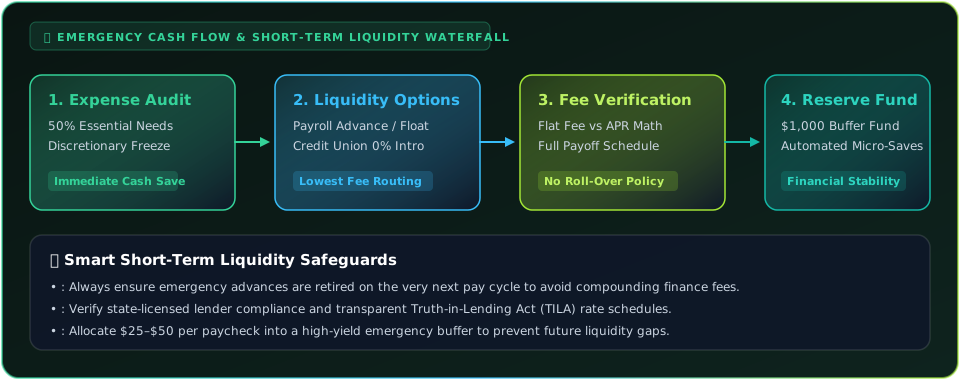
1. The Mechanics of the Cascading Overdraft Fee Trap
When a depositor transacts without sufficient ledger balance, the bank may elect to pay the transaction as a courtesy under an Overdraft Protection Program or decline it as a Non-Sufficient Funds (NSF) event. While banks market this as a convenience to prevent consumer embarrassment at the checkout register, the underlying fee economics are extreme.
Historically, banks charged a flat fee (typically $35) regardless of whether the transaction amount was $3.00 for a morning coffee or $300 for a car payment. When an individual account enters negative territory, subsequent transactions cascade into multiple separate penalty fees:
Initial Checking Balance: $10.00
Transaction 1 (Groceries): $25.00 → Balance -$15.00 (Fee: $35.00) → Balance -$50.00
Transaction 2 (Fuel): $20.00 → Balance -$70.00 (Fee: $35.00) → Balance -$105.00
Transaction 3 (Lunch): $12.00 → Balance -$117.00 (Fee: $35.00) → Balance -$152.00
Total Spent on Purchases: $57.00
Total Overdraft Fees Incurred: $105.00 (184% fee on actual purchases!)
If that $105 fee is repaid upon the consumer's payroll direct deposit four days later, the annualized borrowing cost of that $57 liquidity exceeds 16,000% APR.
2. Transaction Reordering: High-to-Low Processing Practices
A major regulatory battle fought by the Consumer Financial Protection Bureau (CFPB) centered on high-to-low transaction reordering. Historically, many large commercial banks batched daily transactions and cleared them in order of largest dollar amount to smallest dollar amount, rather than chronologically.
By clearing a large $500 rent check first, the bank instantly exhausted the account balance, causing four subsequent small transactions ($4, $8, $12, $15) to bounce individually. This practice turned what would have been a single overdraft event into five separate penalty charges, generating $175 in fees in a single afternoon. While class-action litigation and CFPB supervisory guidance curtailed aggressive reordering, chronological clearing remains essential to minimize fee exposure.
3. Mathematical Break-Even Analysis: Advances vs. Overdrafts
To determine the more economical financial decision during an unavoidable liquidity crisis, examine the comparative economics between a regulated $300 Cash Advance and bank overdraft coverage across common transaction volumes:
| Scenario Dimension | Single Overdraft Event ($35 Fee) | Multiple Overdraft Events (3 Fees) | Regulated $300 Cash Advance ($15/cwt) |
|---|---|---|---|
| Total Upfront Fee | $35.00 | $105.00 | $45.00 (Fixed) |
| Effective Fee % on $300 | 11.67% | 35.00% | 15.00% |
| Impact of Multiple Purchases | Single transaction only. | $35 added per additional debit swipe. | Zero change (cash covers all transactions). |
| Risk to Bank Account | Involuntary account closure if unpaid. | Negative balance reported to ChexSystems. | Bank account remains positive and active. |
The mathematical break-even threshold is clear: if a consumer confronts a single unavoidable payment under $50, paying one overdraft fee or seeking a payment extension is comparable. However, if a household must cover multiple essential obligations (such as prescription medicine, fuel, and groceries), incurring three or four separate $35 overdraft fees ($105 to $140) is far more expensive than a single regulated advance costing $45.
4. Exercising Your Regulation E Opt-Out Rights
Consumers frequently do not realize that they are under no obligation to accept debit card overdraft fees. Under 12 CFR § 1005.17, you can revoke your overdraft consent at any time:
- Contact Your Financial Institution: Access your online banking portal or speak to customer service and request to "Opt Out of Overdraft Coverage for Everyday Debit and ATM Transactions."
- What Happens Upon Opt-Out: If your checking account contains $12 and you attempt to buy a $15 item with your debit card, the card terminal simply displays "Declined." The bank cannot charge an overdraft fee, NSF fee, or administrative penalty.
- Exceptions to Understand: Regulation E applies strictly to point-of-sale debit swipes and ATM withdrawals. Recurring automated ACH debits (such as gym memberships or utility bills) and paper checks are governed by separate deposit agreements and may still incur NSF charges if presented against insufficient funds.
5. Modern Banking Reforms: Grace Periods & Buffer Thresholds
In response to regulatory scrutiny, many competitive consumer banks (including Ally Bank, Capital One, and Discover) have permanently abolished overdraft fees or instituted consumer-friendly safeguards:
- $50 De Minimis Cushion: Many institutions waive overdraft fees entirely if your end-of-day negative ledger balance is under $50, protecting consumers from minor mathematical miscalculations.
- 24-Hour Grace Periods: Progressive institutions provide a 24-hour grace window allowing depositors to transfer funds into their account before an overdraft fee is officially assessed.
- Linked Savings Sweep: Setting up an automatic overdraft transfer from a linked secondary savings account transfers exact dollar amounts for a $0 to $10 fee, avoiding $35 penalty charges entirely.
Cash 4 You Live Editorial & Consumer Advocacy Board
Our financial literacy researchers and regulatory analysts publish independent guides on Truth in Lending APR compliance, credit union PAL alternatives, and state usury statutes.